


Brightbeam AI Perspectives · 13-minute read
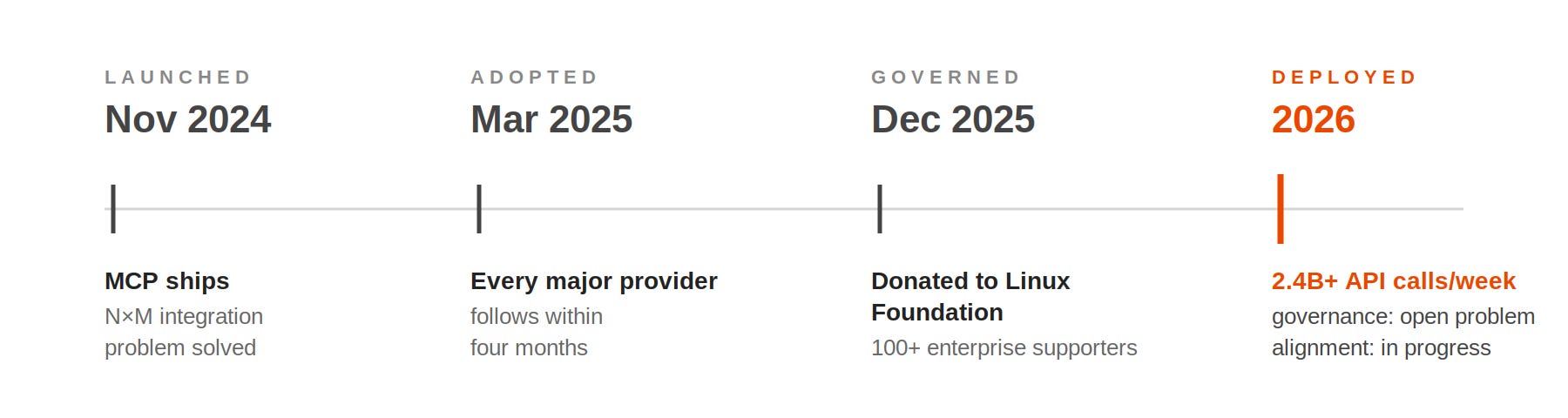
In November 2024, Anthropic published the Model Context Protocol (MCP), a single open standard for connecting any AI model to an external tool, database, or service. By March 2025, OpenAI had adopted it across its Agents SDK, Responses API, and ChatGPT desktop.
By early 2026, MCP had reached 97 million monthly SDK downloads and more than 10,000 public MCP servers – outpacing Docker’s first-year adoption. In roughly 15 months, the AI agent had acquired a standardised interface to nearly every enterprise tool and system it might need to reach.
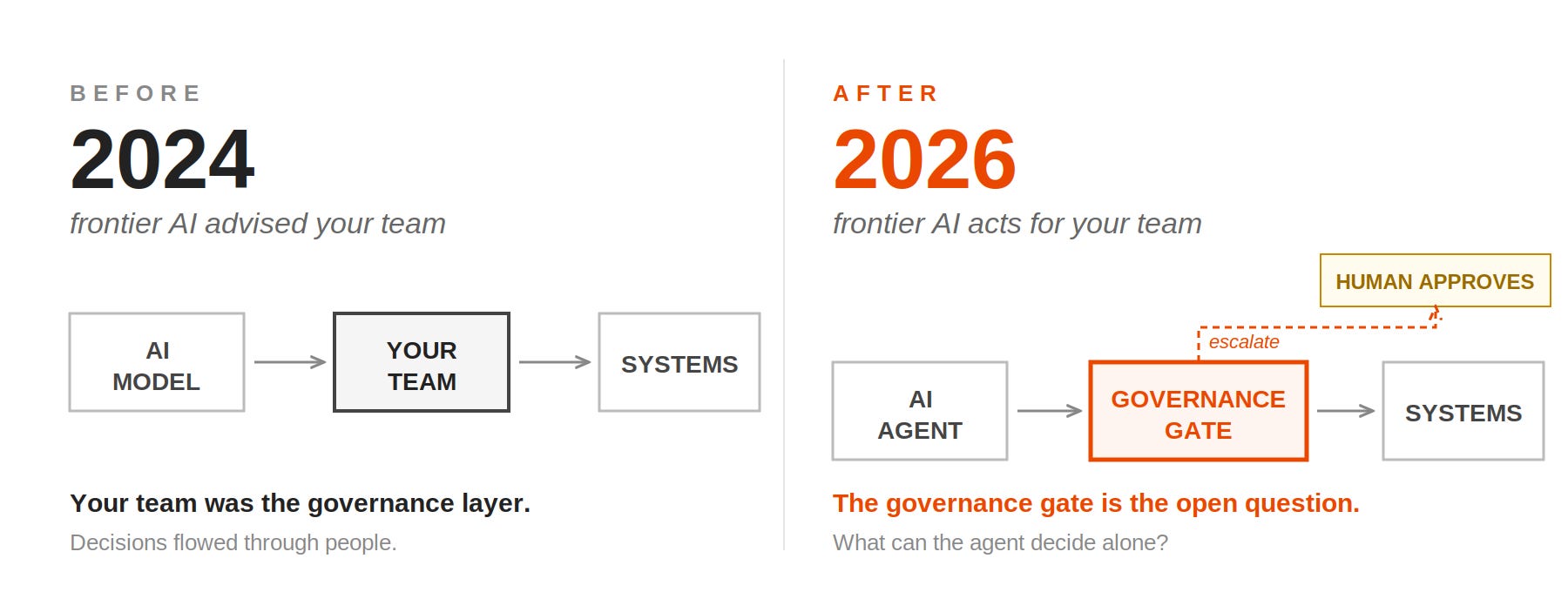
The capability question has been answered. The agent has hands. It can read your database, call your API, update your CRM, send email, run code, and submit a form.
The governance question remains open.
Which of those actions should the agent take alone? Which should it pause and escalate? Which should it be prevented from attempting?
In biopharma, insurance, manufacturing, and any other sector where a wrong action has regulatory or operational consequences, that question determines the deployment decision.
Why this matters now
Claims of urgency around AI often age quickly because the field shifts weekly. This one rests on two developments.
First, the protocol layer has settled.
MCP launched in November 2024 and every major AI provider adopted it within roughly four months – a convergence not seen since REST standardised web services in the early 2000s. In December 2025, Anthropic donated MCP to the Linux Foundation as part of the newly formed Agentic AI Foundation, co-founded with OpenAI, Google, Microsoft, Amazon Web Services, and Block. By February 2026, the foundation had more than 100 enterprise supporters. The tool-interface infrastructure is now open, vendor-neutral, and governed in the same way as Kubernetes and Node.js. It is sufficiently entrenched that organisations building on it are no longer making a technology bet.
Second, deployment reversed an earlier assumption.
In 2023, the reasonable expectation was that capability would be the hard problem: getting a model to reason well enough to orchestrate a multi-step workflow. Governance would follow once capability arrived. The experience of organisations deploying agentic systems in 2025 was the reverse. Capability arrived. A January 2026 survey of agentic architectures on arXiv found that the dominant production failure modes were errors in the governance layer – tool hallucination, error propagation through multi-step chains, and prompt injection through untrusted content – rather than failures of model reasoning. The model was the easier problem.
That experience changes how organisations should frame deployment. The harder question is where the model acts alone.
The governance layer
Imagine a new employee arriving on their first day with access to every system in the building: the CRM, claims management platform, email server, contract repository, and regulatory submission database. Their competence is not the issue. Safe operation depends on whether the organisation has defined what they may do alone, what requires sign-off, and what they cannot touch.
That structure is the governance layer. Most agentic deployments in 2025 were built without one.
The standard architecture for an AI agent has four components: a cognitive core, responsible for reasoning and planning; memory, which maintains state across steps and sessions; tools, meaning the external systems the agent can reach; and a security and guardrails layer, which intercepts and validates every tool invocation before it executes. TrueFoundry’s 2026 survey of agent architectures found that three of the four were consistently present in production deployments. The fourth – the guardrails layer – was typically missing, minimal, or treated as a human process bolted onto the agent loop.
Earlier AI systems did not create the same class of error. A language model that produces incorrect text produces a wrong document. An agent that executes an incorrect action can modify a record, send a communication, submit a form, or trigger a downstream workflow. The arXiv survey put this plainly: once a model can modify files, run code, or operate a system interface, hallucinations produce concrete failures rather than incorrect text. The error class changes.
Research presented at the 2025 International Conference on Machine Learning adds a further complication. It found that reasoning-focused reinforcement learning – the training technique behind the strongest current models – amplifies tool hallucination rather than reducing it. Better general reasoning and better tool-use reliability are in tension at the level of the training objective. Greater capability therefore does not make an ungoverned agent safer; it allows the agent to make worse mistakes more quickly.
The Relign framework, presented at the same conference, proposed an architectural response: expand the agent’s action space to include ‘indecisive actions’ – structured mechanisms for deferring a tool invocation, seeking clarification before acting, or flagging low-confidence calls for human review. This is reliability alignment: training the model to act well when it knows what to do, and to pause correctly when it does not.
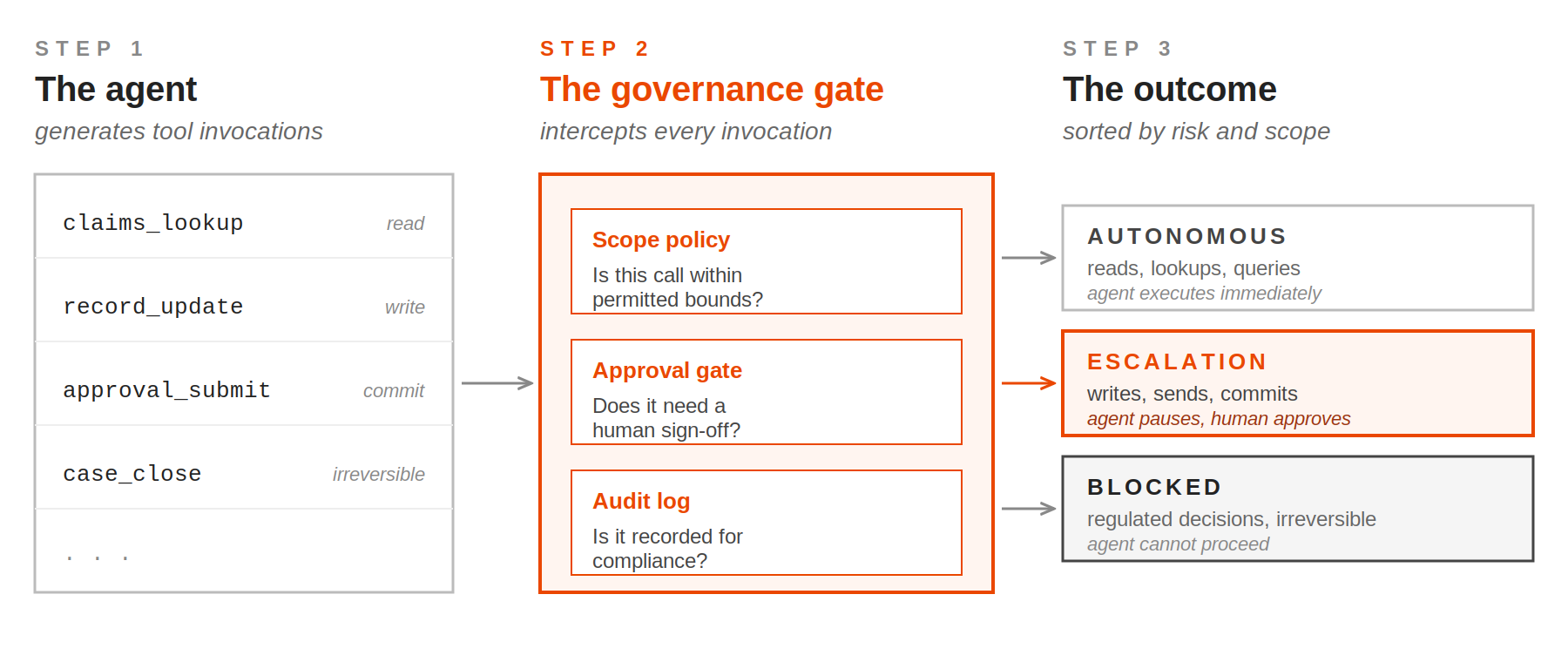
The governance layer is the organisational counterpart to reliability alignment. It sits outside the model and does not depend on the model’s confidence. Invocation by invocation, it determines what the agent does alone, what it escalates, and what it cannot attempt.
Every tool invocation is assigned one of three routes: autonomous, escalation, or blocked. The governance architecture is the set of rules that makes that sorting reliable.
What the protocol changed
The protocol shift changed the structure of integration. Without a shared protocol, connecting N models to M enterprise tools requires N × M custom integrations, each built and maintained separately. With MCP, that falls to N + M connectors to the shared layer. Anthropic identified this problem explicitly when it launched MCP in November 2024; the protocol was designed as the solution. The speed of the resulting adoption shows how acute the problem was.
Google’s Agent-to-Agent protocol (A2A), released in April 2025, extended the same logic to multi-agent coordination, giving networks of specialist agents a standard for discovery, delegation, and collaboration. IBM’s Agent Communication Protocol merged into A2A in August 2025. The three-layer stack – user intent, A2A coordination, and MCP tool access – is now the consensus architecture.
Production reliability remains unsettled.
The Berkeley Function Calling Leaderboard (BFCL) tests single-step, well-specified function calling under clean conditions. Klavis AI’s analysis found strong benchmark results among the leading models: Claude Sonnet 4 at 70.29% and Claude Opus 4.1 at 70.36%. MCPMark, which tests 127 end-to-end MCP workflow tasks with real tool schemas and noisy inputs, showed substantially lower performance across the board. The gap between the two measures highlights the governance problem: it shows how much of a model’s benchmark accuracy depends on conditions a real workflow will not provide.
Sesame Disk’s May 2026 analysis of multi-agent coordination found that adding agents without matching governance and coordination infrastructure produced worse outcomes. The organisations performing best had not deployed the most agents. They had built the most disciplined governance around fewer of them.
What the gap means in practice
The consequences of the governance gap vary by sector.
Regulated sectors – structural
Biopharma · insurance · manufacturing
A clinical trial data agent that modifies a subject record, an insurance claims agent that approves or declines a payment, and a quality-control agent that passes or fails a manufactured batch are each making a regulated decision. The audit trail must meet the evidentiary standards of the relevant regulator, not merely the organisation’s internal standards. Governance is not optional configuration. In these sectors, it is what makes deployment legal.
Professional services – operational
Legal · financial advisory · consulting
Professional judgement is the product. An agent that drafts, reviews, advises, or executes without a documented human decision in the chain creates liability exposure that most firms cannot absorb. Governance allows the productivity gain of agentic AI to coexist with the professional obligations that justify the client relationship.
Software and IT operations – performance
CI/CD management · incident response · security operations
Agent actions in code and infrastructure are largely observable and often reversible. The governance architecture can therefore be built and tested more quickly. Evidence from Amazon’s internal deployments – thousands of agents in production by 2025 – suggests this is where deployment is furthest advanced. Governance allows the speed advantage of agentic operations without cascading failures in production systems.
Customer-facing workflows – economic
Claims processing · order management · service resolution
The value case rests on volume. An agent that completes a routine claim end-to-end, or resolves a standard service issue without handoffs, can deliver economic value at a scale no human team can match. Governance makes it safe to route that volume autonomously, rather than keeping a human in every loop as a liability hedge.
Three key questions
01. Can you draw the line?
For the workflow you most want to automate, can you name precisely which actions the agent takes alone, which require human approval, and which it cannot attempt? If you can’t, the workflow is not ready for autonomous execution, regardless of the model’s capability. The governance architecture must exist before the agent can be trusted to operate within it.
02. Do your compliance frameworks have a category for this?
Most existing compliance frameworks cover decisions made by humans and decisions made by software following deterministic rules. They typically do not have a category for decisions made by a probabilistic reasoning system acting on its own judgement. The agent has hands; the compliance framework has not yet decided what it may sign. That gap is a governance design problem.
03. What is your tool-call failure rate on your real workload?
This is the measurable question. A 5% tool-call failure rate on a workflow running 100 times a day creates five exceptions to handle. The same failure rate on a workflow running 10,000 times a day becomes a production incident every few hours. Run representative prompts against your actual tool set and measure success rate, error type, and downstream cascade rate. Do not rely on a benchmark. Those numbers tell you whether you have a model problem, a tool-quality problem, or a governance-architecture problem.
Together, the answers tell you whether governance has become the binding constraint for your organisation in the past 12 months.
Where this lands
For most AI workloads, human mediation remains the right answer. The case for autonomous execution in a high-stakes workflow must be built workflow by workflow and supported by measurement. The existence of protocol infrastructure does not establish it.
BFCL results from Klavis AI show top-model performance at around 70% on controlled function-calling tasks, while MCPMark performance on end-to-end workflows is substantially lower. By the first quarter of 2026, enterprise agentic deployments were routing more than 2.4 billion API calls a week through multi-agent frameworks. The scale of production deployment is real and growing. The ICML 2025 work on reliability alignment shows that training models to know when not to act is a tractable research direction with early results. Governance tools such as Arize, Langfuse, and LangSmith are maturing.
None of this changes the immediate situation. In regulated environments, disciplined governance around what models can do alone matters more than possessing the most capable model.
Brightbeam works through that problem at the level of a specific workflow: drawing the lines, designing the escalation structure, and building the audit capability a regulated environment requires. If your team is now living with the governance question, we would welcome the conversation.
For technical readers
A practical guide to the execution pattern, the evidence, and the first steps.
The mechanism
The core execution pattern in every agentic system is the ReAct loop (Yao et al., 2022): the model reasons about a task, emits a structured tool call, receives the result, and incorporates it into further reasoning. At inference time, the model emits a JSON object rather than prose:
{"tool": "claims_lookup", "claim_id": "CLM-29471"}The application layer executes the function and injects the result back into context. The loop continues until the task is complete.
The governance architecture intercepts each tool invocation before execution and applies three checks:
Scope policy – is the call within the agent’s permitted action space?
Approval gate – does this action require human authorisation?
Audit – is the call being logged for compliance purposes?
The intercept layer is architecturally separate from the model. It does not improve or degrade the model’s reasoning. It constrains what that reasoning is permitted to produce in the world.
Yin et al. (ICML 2025, arXiv:2510.22977) showed why this becomes non-optional in regulated deployments. Reasoning-focused reinforcement learning amplifies tool hallucination at the level of the training objective. The model becomes more confident in its tool calls as its general reasoning improves, but that confidence is not matched by greater accuracy on rare or edge-case tools.
The Relign framework (ICML 2025, arXiv:2412.04141) responded by expanding the agent’s action space to include indecisive actions: structured deferral, clarification requests, and explicit low-confidence flags. The practical implication is direct: do not expect better models to solve the governance problem. Build the intercept layer.
The numbers
Berkeley Function Calling Leaderboard
Controlled, single-step function calling with well-specified schemas and clean inputs:
Claude Opus 4.1: 70.36%, ranked second as of mid-2026.
Claude Sonnet 4: 70.29%, ranked third.
MCPMark
Across 127 end-to-end MCP workflow tasks with real tool schemas and noisy inputs, performance falls substantially below BFCL for every model tested. Source: Klavis AI, 2025. The precise gap depends on the workload; degradation on your own tools and prompts will differ.
Progressive tool discovery
Klavis AI’s Strata MCP Server and the Tool Search Tool pattern formalised in Spring AI in December 2025 address another production constraint. Loading all available tool schemas at once degrades task completion and increases cost once the tool set exceeds roughly 20 to 30 schemas. A meta-tool for dynamic discovery achieved close to 2× task completion on representative production traffic, at lower cost. The gains concentrate in large tool sets and long-context workflows.
Conditions matter
BFCL accuracy drops significantly with ambiguous or underspecified tool schemas, tool sets larger than 30 to 40 schemas loaded at once, multi-step chains in which early errors compound, and real-world prompt noise. The gap between benchmark conditions and production conditions is the variable that matters most.
Practical Next Steps
Install
For LLM observability, install either Langfuse or LangSmith:
pip install langfuse>=2.0or
pip install langsmithBoth instrument tool-call success rate, latency, and error type without requiring changes to the model or tool implementation.
For prompt-injection defence at the MCP boundary:
pip install llm-guardFor serving with built-in tool-use support:
pip install vllm>=0.6vLLM supports MCP-compatible tool dispatch from version 0.6.
Try
Instrument a single agent workflow with Langfuse. Run 200 prompts drawn from your actual workload distribution. Do not use synthetic test cases or benchmarks. Log every tool call: tool name, parameters, success or failure, latency, and any downstream cascade. Establish a baseline before optimising anything. On a workload with existing agent infrastructure, the experiment runs in an afternoon.
Measure
Tool-call success rate on representative prompts.
Error-cascade rate – how often a single tool failure causes a downstream failure in the same chain.
Latency at the typical context length and tool-set size.
These three numbers tell you whether the problem sits in the model, tool quality, or governance architecture. BFCL scores alone cannot answer that question. They also tell you which of the three moves first.
Watch
Infrequently called tools. A tool invoked once a day is orders of magnitude more vulnerable than one invoked 1,000 times a day because the model has less in-context evidence about its correct signature.
Long, multi-step chains in which a mid-chain error remains invisible until the final output.
Prompt injection in retrieved content. An attacker-controlled string in a database row can redirect the agent’s subsequent tool calls. CVE-2025-6514 exposed more than 437,000 environments through this vector.
Read
Yin et al., ‘The Reasoning Trap: How Enhancing LLM Reasoning Amplifies Tool Hallucination’ (2025), arXiv:2510.22977, for the mechanism behind the tension between capability and reliability.
The Langfuse documentation, for the instrumentation starting point.
Relign (ICML 2025), arXiv:2412.04141, for the reliability-alignment research direction.
This Perspective began as a discussion inside Brightbeam’s Digital Intelligence: State of the Art and Beyond (DI SOTA and Beyond) programme, a standing forum where the people building production AI systems argue through what is real, what is hard, and what is merely fashionable. The thinking here is collective. The argument was sharpened in the room before it was written down.