


In May 2026, Google released first-party multi-token prediction (MTP) drafters for the Gemma 4 family, under Apache 2.0, runnable on a single workstation GPU. The release notes report up to a 3× speedup, with no measurable loss in accuracy.
It was the third significant release in this direction in eighteen months. DeepSeek-V3, released in December 2024, shipped with MTP heads built into the main model. EAGLE-3, published by Li et al. in March 2025, extended speculative decoding with a tree-attention drafter and reported 4–6× wall-clock improvements on standard benchmarks.
Over the summer, the same techniques moved further into the production stack. In late August, vLLM published testing across five speculative-decoding approaches and several model families, finding gains that varied sharply by workload but, in the strongest configurations, more than doubled throughput.
The research results point in the same direction: substantially faster decoding, accuracy preserved, on hardware your organisation can actually own. The production evidence adds an important qualification – the size of the gain depends on the model, workload and serving conditions.
The assumption these releases challenge is that frontier-quality reasoning at frontier-class speed requires a frontier-class data centre. With weights now portable and inference fast enough to run inside the organisation, the practical question moves from whether AI can be deployed inside the perimeter to which AI, on what hardware, with what audit trail.
For regulated workloads, where the data could never leave the perimeter, this may unblock a class of projects that have been on the roadmap for two years.
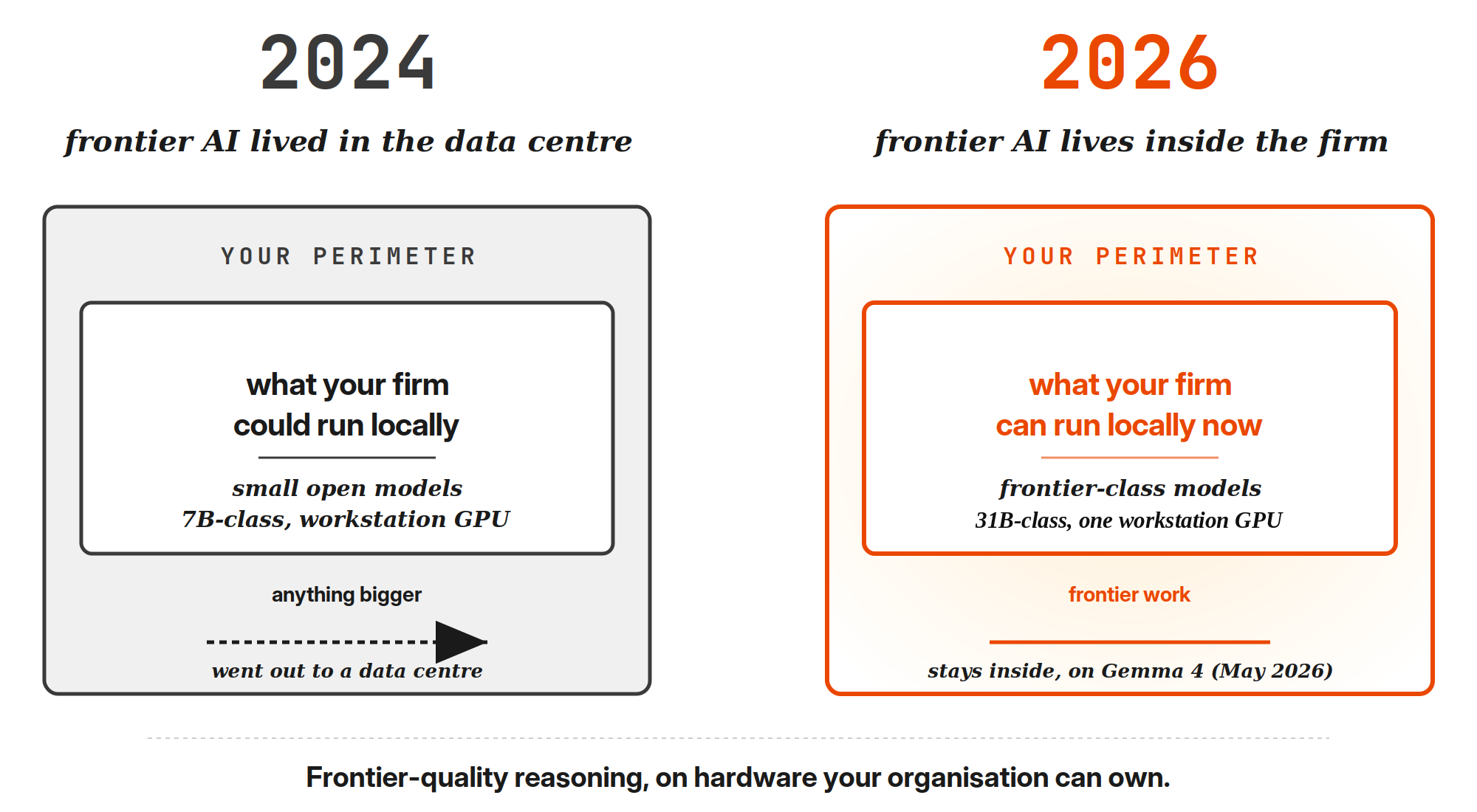
Most public discussion of open AI infrastructure has been about model access: which weights are open, who can fine-tune them, what licences apply. Weight access has been broadly available for two years; that part of the conversation has matured.
The constraint that was actually binding for regulated organisations was quieter. Even with the weights in hand, running a competitive model on hardware the organisation controlled was often slow enough to make the deployment impractical. The model could be technically present inside the perimeter but functionally unusable.
Multi-token prediction changes that arithmetic.
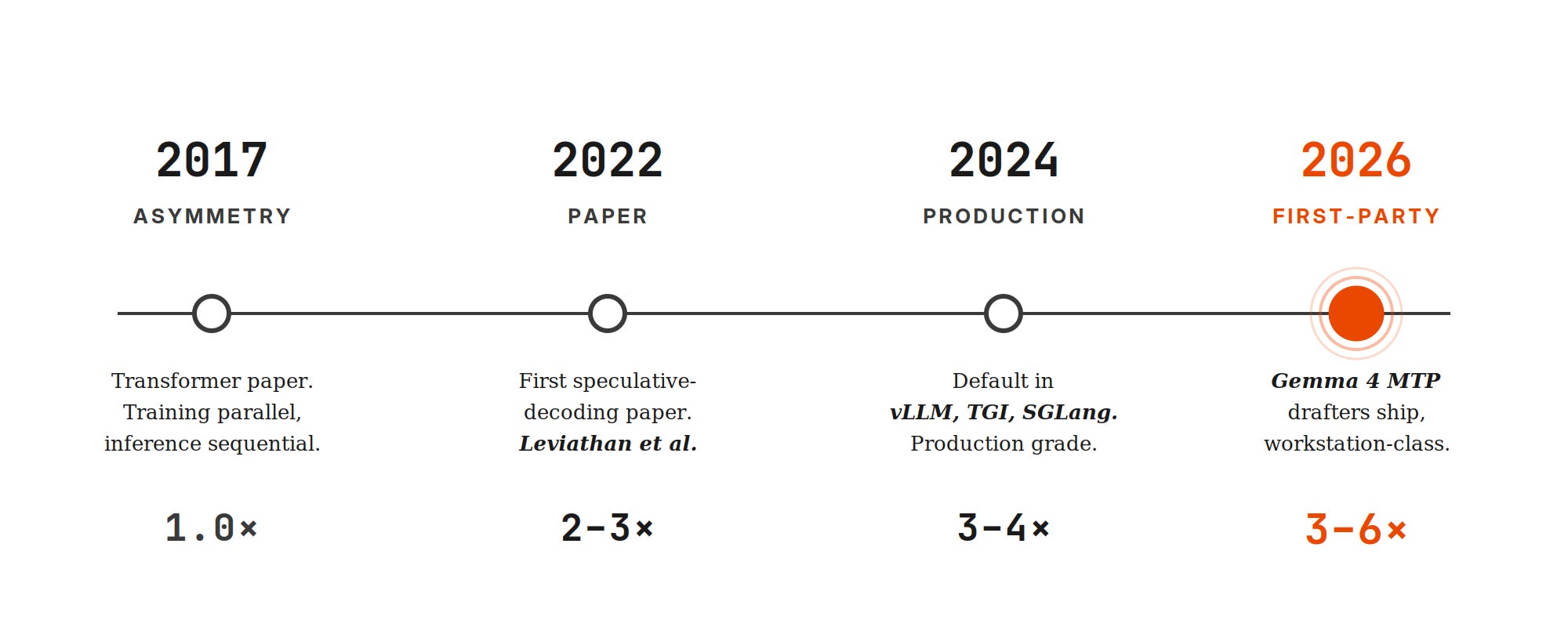
The technique itself is not new. The original speculative-decoding paper by Leviathan et al. in 2022 established the proof that a small draft model can propose tokens for a larger model to verify, with no loss of accuracy. By 2024, it was available in serving frameworks such as vLLM and TGI.
What changed over the past year is that the technique started shipping as a first-party feature of the open models themselves, with implementations for server-class, desktop and edge deployment. And over the summer of 2026, support around those models continued to mature.
Organisations that had been waiting for AI fast enough to run inside the perimeter found that the wait shortened materially.
This is the development worth reconsidering. The model-selection question – which weights are good enough – has largely been answered for a growing range of workloads. The deployment-economics question – whether the chosen weights can run fast enough on owned hardware – has changed.
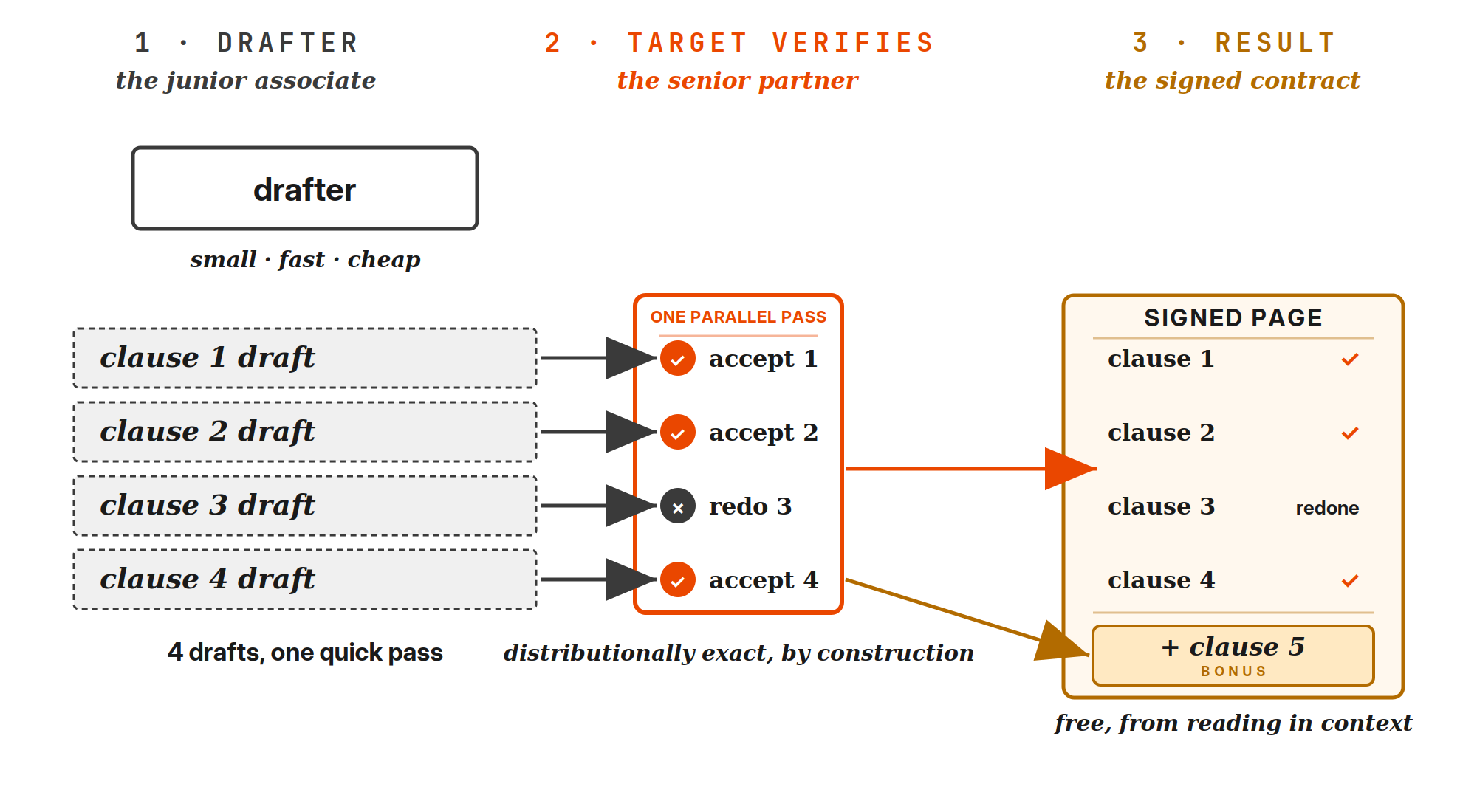
The drafter proposes. The target signs. The work stays inside.
Think about how a contracts team works through a complicated document.
A junior associate produces a quick first draft of the next several clauses, working from instinct and the firm’s house style. A senior partner reads the draft in one sitting, deciding clause by clause whether to accept what the associate wrote: clause one stamped, clause two stamped, clause three flagged for rewrite, clause four stamped.
The partner’s judgement is preserved; the firm’s standards are unchanged. The work moves faster because the partner did not start each clause from a blank page.
There is one further effect that matters. While the partner is reading clause four, they are already forming an opinion about clause five, even though the associate did not propose it. The thought is there as a consequence of reading the document in context.
In speculative decoding, the equivalent happens at every verification step: the large model also produces a prediction at the position after the accepted draft sequence as a structural side effect of parallel verification. That additional token helps explain why an expensive target-model pass can produce more useful output than standard decoding.
It does not make speculation free. Recent production testing shows that at higher concurrency, rejected proposals can consume compute that could otherwise serve real tokens, reducing or even eliminating the gain.
That is what multi-token prediction does. A small, fast model – the drafter – proposes several tokens at once. A large, accurate model – the target – verifies them in a single parallel pass, accepts the tokens that match what it would have produced anyway, and replaces any that do not.
Multi-token prediction is a patch on a long-standing efficiency problem. The 2017 transformer paper set up an asymmetry that has shaped GPU inference ever since: training is naturally parallel because the full sequence is known, but inference has had to be sequential because each new token depends on the previous one.
To produce each token, the accelerator drags every model parameter through GPU memory, completes the mathematical work, then begins again. The technique uses otherwise idle capacity by speculating on what the next several tokens are likely to be and verifying the guesses in parallel.
The senior partner has been re-reading every contract from the first word every time because the firm’s workflow was never designed for an intern. Multi-token prediction is the workflow redesign. Same partner, same standards, fewer wasted reads.
This is one of the more operationally important efficiency improvements of the past three years, and it is incremental rather than transformational.
The strong version of the claim is ‘3–6× speedup, no quality loss’; the careful version qualifies that with workload conditions. The published speedups hold most reliably on short-context, single-batch inference at low temperatures, on workloads where the drafter has been trained on similar distributions. The gains shrink with long context, higher concurrency and some mixture-of-experts targets where routing or verification overhead can dominate the drafter savings.
The strong claim describes what has been demonstrated. The careful version determines whether the technique helps a specific workload.
What the speed shift means depends on the work
Biopharma
Blinical-study reports · regulatory submissions · pharmacovigilance triage · GxP-validated authoring
A class of authoring and review work that previously required hosted API calls may now run on validated on-premises hardware without sacrificing model size.
The compliance question shifts from whether the model can be inside the perimeter at all to which model, audited how, with what retention policy. An existing constraint becomes a tractable engineering choice.
Insurance
Underwriting copilots · claims-fraud triage · document extraction with hard latency floors
The per-token cost of running a competitive model on workstation GPUs has fallen far enough that in-house inference may be a real alternative to per-call API pricing for high-volume traffic.
The decision shifts from outsourcing capacity to owning it, and the budget conversation moves from per-call line items to hardware depreciation. A class of workloads that was not viable in-house at the previous speed may now be viable.
Manufacturing and sovereign workloads
Export-controlled engineering · defence-adjacent design work · sovereign-data jurisdictions
Workloads that were not viable inside the perimeter because latency made the model unusable may now become viable.
The contractual question moves from whether AI may be used in this jurisdiction at all to which model fits the controls. A class of work that could not previously be deployed practically inside the perimeter may now be able to.
Consumer SaaS, retail and ad-tech
Most workloads without sovereignty, residency or compliance constraints
Where audit pressure is low and the model can sit anywhere convenient, hosted inference remains the right answer for many workloads.
Most of the publicly available literature on AI applications was written for this context. The placement decision still matters, but the consequences of getting it wrong are bounded by the use case.
Three questions worth asking about your own deployment
1. What share of your most important AI workload – measured by token volume over the past 30 days – runs on hardware your organisation does not control?
If the answer is ‘all of it’ and there is no compliance reason to change that, multi-token prediction is interesting but not urgent.
If the answer includes a workload stuck behind compliance, the deployment economics have moved. The gap between workloads that can run hosted and those that cannot is where the integration work has to happen.
2. On your own production traffic, what acceptance rate does a candidate drafter achieve?
The published 3–6× speedups come from controlled benchmarks. Code generation typically runs higher; long-context reasoning chains and unusual prompts may run lower.
The relationship between acceptance rate and end-to-end speedup is non-linear and steep, so the first measurement you take on your real workload is more informative than any benchmark someone else ran.
The late-August production evidence reinforces that point. The same serving framework, hardware family and speculative technique can produce materially different gains across different models and workloads.
This number sets the realistic ceiling for what the technique will deliver in your specific deployment.
3. What is the binding constraint that has kept your most important AI workload hosted to date?
If the constraint is model quality – the in-house model cannot do the task well enough – multi-token prediction does not help.
If the constraint is speed on hardware you control, it may be what closes the gap.
The distinction is worth making explicit because the budget conversations that follow look completely different.
Together, the answers tell you whether the inference-economics shift of the past year has changed anything for your organisation.
For most AI workloads, hosted inference will remain the right answer. Model selection is wide, the operations stack is shared with the cloud provider and the audit pressure is bounded.
Where audit pressure is high or sovereignty constraints apply, the empirical evidence points in the same direction from several independent sources.
EAGLE-3, published by Li et al. in 2025, reports 4.1–6.5× speedups on Vicuna 13B and Llama-3.3-70B at temperature zero. Google’s Gemma 4 MTP releasereports up to 3× across the 31B dense and 26B mixture-of-experts variants. And late-August testing from vLLM found roughly 2× gains for Gemma 4 31B across several benchmark workloads, with higher gains in some 26B configurations.
Realised performance varies sharply with hardware, workload and serving conditions. The headline number is a ceiling, not a guarantee.
The common result matters more than the exact multiplier: at workstation scale, the same model can be made meaningfully faster without replacing the target model itself.
For regulated deployments where in-perimeter inference at production speed was the binding constraint, that shortens the step from an available model to a viable production setup.
Working through what that means for a specific organisation – which workload to move first, what hardware to commission, what acceptance rate to expect and what to measure once the system is in production – is what we do.
If your team is now living with that question, we would welcome the conversation.
For technical readers
Mechanism, numbers and what to try this week.
The mechanism
The technique is called speculative decoding, equivalently draft-and-verify decoding.
A small, fast model – the drafter – proposes several tokens autoregressively. A large, accurate model – the target – verifies them in a single forward pass. Tokens whose probability under the target matches their probability under the drafter, modulo a rejection-sampling step that preserves the target distribution, are accepted. The first rejected token is replaced with a sample from the corrected target distribution.
The target’s forward pass also produces a next-token prediction at the position after the accepted draft sequence, which contributes to the efficiency of the procedure. In production, however, speculative decoding can still lose throughput where rejected proposals consume scarce compute, particularly at higher concurrency.
Three release branches are worth knowing.
DeepSeek-V3, released in December 2024, embeds MTP heads directly into the main model, sharing weights to predict the next several tokens during training.
EAGLE-3, published by Li et al. in March 2025, trains a lightweight draft network that operates on the target model’s hidden states, using a tree-attention pattern to explore multiple draft branches in parallel.
Google’s Gemma 4 MTP release in May 2026 packages first-party drafters under Apache 2.0 for the 31B dense and 26B mixture-of-experts Gemma 4 models.
The three approaches differ in architecture but converge on the same operational objective.
The original speculative-decoding proof is in Leviathan et al. in 2022, which established the rejection-sampling step that preserves the target distribution. The work since has been about better drafters, better verifier kernels and tree-search variants.
The numbers
EAGLE-3 on Vicuna and Llama. 4.1–6.5× wall-clock speedup at temperature zero, batch size one, context length under 4k tokens, on H100 GPUs. The 6.5× figure is for Llama-3.3-70B; the 4.1× is for Vicuna-13B.
Gemma 4 MTP. Google’s May release reports up to 3×. Late-August vLLM testing provides a useful production-oriented comparison: Gemma 4 31B reached roughly 2× across GSM8K, MATH500, HumanEval and MBPP at the strongest tested settings, while the 26B mixture-of-experts model reached higher gains on some configurations.
These numbers do not extrapolate cleanly. Speedup varies with context, concurrency, drafter acceptance, model architecture and hardware. The closer your workload resembles the conditions under which a benchmark was measured, the more relevant the benchmark becomes.
Install
For Gemma 4 with MTP drafters, use the current serving documentation rather than relying on a pinned package version. In current vLLM, speculative decoding is configured through --speculative-config; Gemma 4 assistant checkpoints use its dedicated MTP path.
Try
Generate 500 tokens of representative production traffic on one workstation GPU, with and without the MTP drafter enabled.
Log tokens per second on both runs and compare. Then repeat at the concurrency or batch sizes the production system will actually see.
The smallest version of this experiment still fits comfortably inside an afternoon.
Measure
Acceptance rate on your real prompts, not on HumanEval.
Wall-clock latency at your typical context length, not at the benchmark default.
Tokens per second per watt if your GPU budget is power-constrained rather than capital-constrained.
Each metric is something you will eventually have to defend in a budget conversation.
Watch
Three known failure modes.
Long context can compress the gain as verifier key-value cache pressure grows.
Higher concurrency can flatten or eliminate the speedup as speculative tokens begin competing for compute.
Mixture-of-experts routing and drafter overhead can swallow the savings on some workloads.
Read
Two starting points: Leviathan et al. in 2022 for the original proof, and the current vLLM speculative-decoding documentation for the production implementation.
Google’s Gemma 4 release notes and vLLM’s August 2026 benchmarkingprovide useful reference points for how the technique is performing now.
This Perspective began as a discussion inside Brightbeam’s Digital Intelligence: State of the Art and Beyond (DI SOTA and Beyond) programme, a standing forum where the people building production AI systems argue through what is real, what is hard, and what is merely fashionable. The thinking here is collective. The argument was sharpened in the room before it was written down.