


Brightbeam AI Perspectives · 15-minute read
The shift
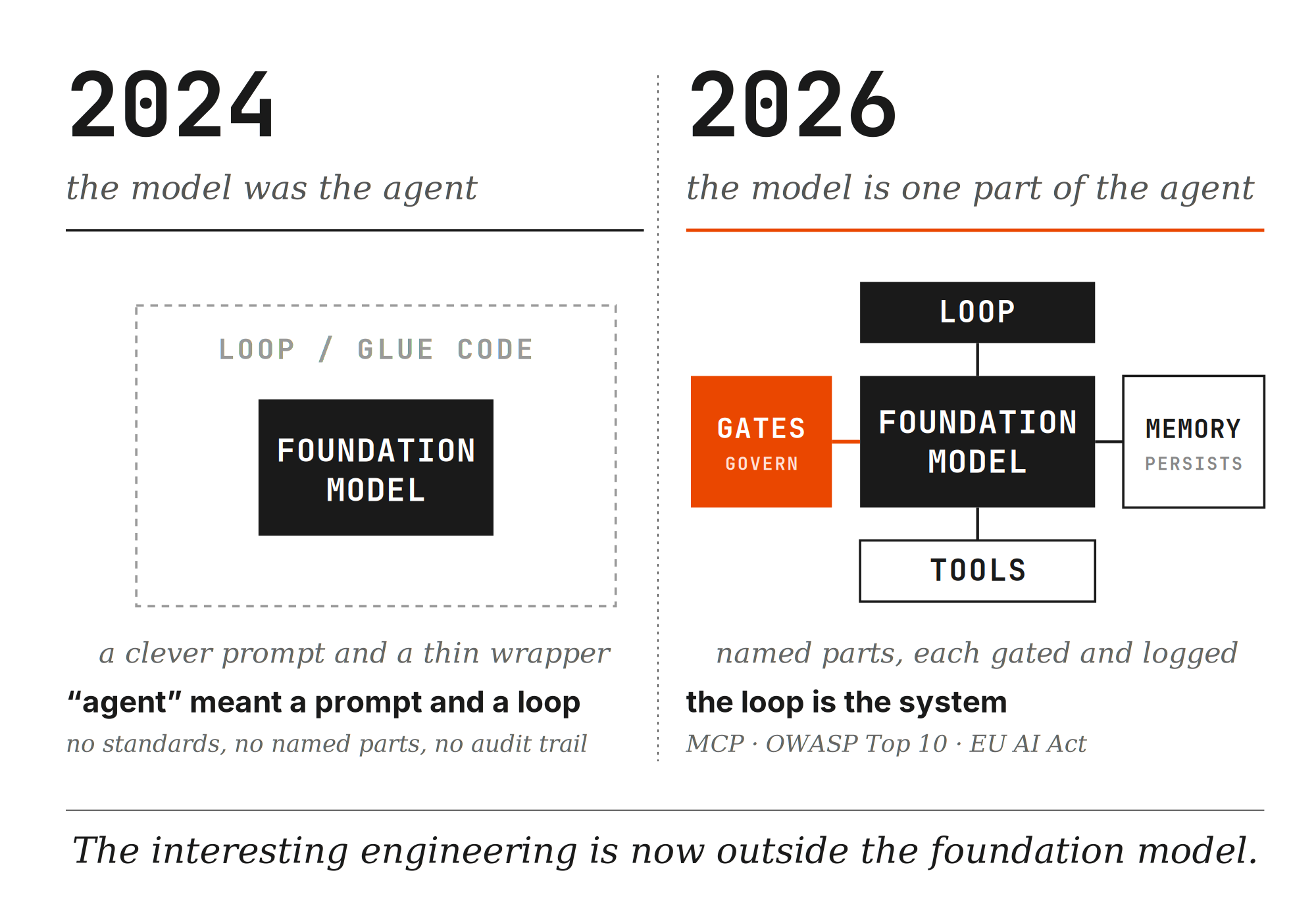
An agent in production today is, by volume of code, mostly scaffolding. The foundation model – the large language model doing the reasoning – is one component. Around it sit an iterative loop, memory that persists between steps, tools the model can call, and gates that determine what each call may do.
Practitioners who build these systems put the balance bluntly: the model may be a small part of the implementation; the code governing what it can and cannot do is most of it. That balance can look unfamiliar if AI has been viewed mainly through model releases. It also changes what a buyer is purchasing when they procure an agent.
Why this matters now
The connection layer has begun to settle, largely around open standards. Anthropic introduced its Model Context Protocol in November 2024 to standardise how agents reach tools. By December 2025, it had been adopted across major AI products and donated to the Linux Foundation. Google’s Agent2Agent Protocol (A2A), which lets agents discover and delegate to one another, reached its first stable specification in April 2026, with more than 150 organisations supporting it.
A newer layer addresses a different question: how an agent defers to a person who remains accountable. Brightbeam’s Collaborative Human-Agent Protocol (CHAP) sits here. It records human interventions in an append-only, hash-chained log – evidence that oversight can be implemented and replayed without weakening the underlying obligation.
Security guidance and regulation hardened on a similar timeline. OWASP published its Top 10 for Agentic Applications in December 2025, giving builders a shared catalogue of agent risks. The EU AI Act still brings transparency duties into force in August 2026. The July 2026 AI Omnibus moved the main high-risk obligations – including logging and human oversight – to 2 December 2027 for Annex III systems and 2 August 2028 for systems embedded in regulated products.
The practical consequence is that buyers now need to evaluate the system around the model as carefully as the model itself. Procurement moves beyond ‘which model?’ to ‘what does the loop look like, what governs each iteration, and what evidence remains at the end?’ Much enterprise AI strategy still frames the question one layer above where the operational risk now sits.
The model decides what to do.
The loop decides whether it is allowed to
The gates decide whether anyone will know what it did.
How it works
The cognitive core rarely produces the result in one shot. It runs a loop: read the situation, decide what to do next, act, observe the result, repeat. Two familiar patterns describe this shape. ReAct, published by Yao et al. in 2022, interleaves reasoning, action, and observation step by step. John Boyd’s OODA loop – Observe, Orient, Decide, Act – makes the update to the world model explicit before a decision, which matters when the environment changes between iterations.
OODA is a useful frame, though today’s coding agents – Claude Code among them – more often run a ReAct-style loop. Orientation is folded into the reasoning step instead of becoming a separate, deliberate stage. The distinction matters little in a tight coding session. It matters more as agents take on longer work in environments that change beneath them.
A workshop is a useful analogy. The cognitive core is the apprentice: capable of reasoning, still liable to error. The loop provides the rhythm; the tools are the equipment; the gates are the senior craftsperson deciding what leaves the bench. Each pass through the loop produces a partial result that must clear a gate before it becomes an action in the world.
A concrete example is Claude Code. Its gates can be implemented as lifecycle hooks – small pieces of code that fire at defined points in a run. A UserPromptSubmit hook fires before the model processes the prompt; it can add relevant context, validate the prompt, or block it from being processed. A PreToolUse hook fires before a tool call; it can allow or block the call, request human approval, or alter its arguments. A PostToolUse hook fires after a successful call; it can run a linter, append the result to an audit log, or feed the output into the next reasoning step. A basic command hook is a JSON entry in a settings file pointing to a script. The script receives the event payload on standard input and returns its decision on standard output.
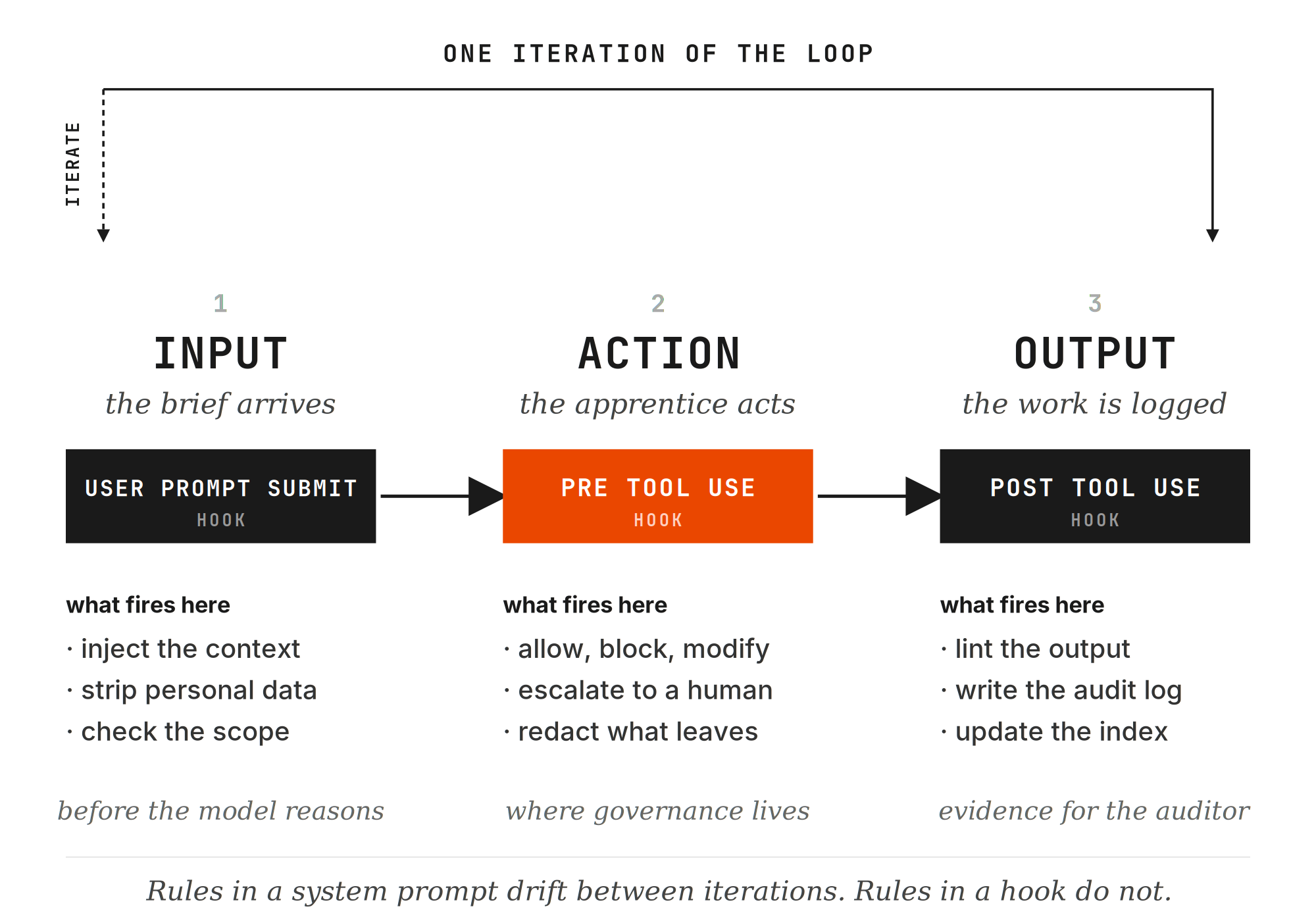
This implementation exposes the central architectural point: important rules should not depend on the prompt alone. A system-prompt instruction such as ‘never share customer data externally’ can weaken as context is summarised or compacted across a long run. A PreToolUse hook that redacts personal data on every matching outbound call is evaluated each time, regardless of what the model has remembered. Prompt instructions can drift. A correctly configured code gate does not depend on the model remembering the rule.
Where this sits
This is a patch on the existing shape of the technology, not a revolution. The model still does the reasoning. The engineering around it has matured into a distinct discipline, with named protocols, published security guidance, and a regulatory frame that looks for evidence at the points where actions are permitted.
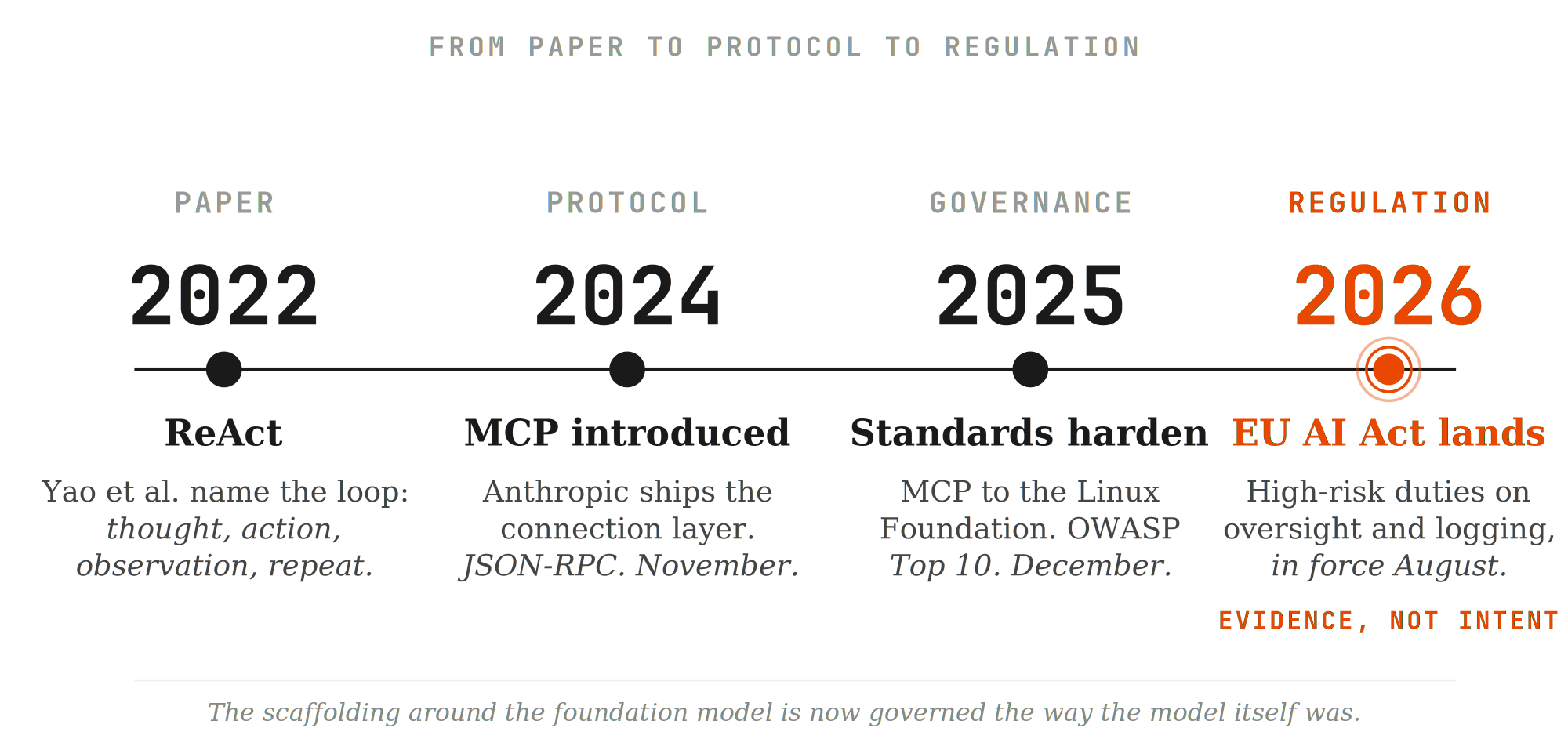
The lineage matters because it shows that the system around the model is now subject to the same kind of governance - and the same kind of independent commercial maturity - that the model itself went through. A buyer who treats ‘an agent’ as a single product loses sight of what they are buying at each layer. The protocols are open, the threat catalogue is named, and the regulatory timetable is explicit. Two years ago, those conditions were still forming.
What it means for whom
The implications differ by sector, but the buyer is evaluating the same thing: the loop, its tools, and its gates.
Biopharma – structural
Clinical trial protocol review · regulatory submission drafting · adverse event triage
Agentic workflows that touch patient data or affect submissions need every consequential action to pass through a programmatic gate, with an audit trail an inspector can reconstruct. The hooks generate that evidence as the work happens. The gate sets the operational boundary on the model’s behaviour.
Insurance – operational
Claims triage · underwriting assistance · fraud signal aggregation
Many bounded insurance workflows fit a single-agent loop. The practical test is whether the policy gate catches every call to a customer record. Without it, an agent summarising three claims may carry the wrong claimant’s data into the fourth.
Manufacturing – economic
Predictive maintenance · supplier risk monitoring · documentation generation
Agent loops let small teams cover ground that was previously a documentation burden, but the economics turn on tool cost and gate overhead. Code-mode tool use, where the agent writes Python that calls many tools through one execution environment, can cut context usage by roughly an order of magnitude on the agents that have adopted it.
Sovereign workloads – structural
Defence procurement · public administration · regulated critical infrastructure
The human oversight formalised in the EU AI Act is operationally close to the gate-based architecture described here. It is also the layer CHAP was built for: oversight, intervention, and logging implemented as first-class system functions.
Three questions worth asking
These are diagnostics for a team that has, or expects to have, an agent in production. The answers should name specific calls, gates, escalation points, and logs.
01. What percentage of your agent’s consequential tool calls pass through a programmatic gate, rather than a prompt instruction?
A loop that relies on the system prompt to refuse certain actions carries a predictable source of drift. The operating target is 100%: every consequential call passes through code that can allow, block, or escalate it. Any lower figure identifies an ungated part of the system.
02. Where in your loop can a human intervene, and in what format?
‘Human in the loop’ often hides more than it tells. A useful answer names the hooks where intervention is possible, the conditions that trigger an escalation, and the form the human response takes – approve, revise, or escalate – and records it as a structured verdict.
03. Could an auditor reconstruct any of your agent’s decisions from your logs alone?
If the answer also requires the system prompt, the logs do not yet form a complete audit trail. They describe intent without reconstructing the decision. The AI Act’s high-risk rules are written around logging and human oversight. A system prompt alone cannot provide either.
Together, the answers show whether governance lives in the runtime system or in its stated intentions.
Where this lands
For most enterprise AI workloads, an agent is unnecessary. A hosted assistant performing a clearly defined task, with a person reviewing the output, will often deliver more value with less governance overhead. An agentic loop earns its place when each decision depends on what the previous step found. At that point, model capability is only part of the design; the location and behaviour of the gates matter just as much.
The supporting infrastructure is now concrete. A2A moved to the Linux Foundation in June 2025; MCP followed into its Agentic AI Foundation that December. OWASP’s Top 10 for Agentic Applications, published in the same month, gives builders a shared catalogue of risks including goal hijacking, tool misuse, and memory poisoning. Simon Willison’s ‘lethal trifecta’ – private data, untrusted content, and an outbound channel – remains useful shorthand for one prompt-injection path.
Lived practice points the same way: practitioners report that roughly eighty percent of the effort in deploying agentic AI goes into data engineering, governance and integration rather than into prompts or model tuning, and the floor of competence rises as the hooks accumulate.
This is where the work has moved: mapping the loop, deciding where the gates sit, and measuring whether they hold. It is also the work Brightbeam does with organisations putting agents into production. Where governance still lives mainly in the prompt, there is usually a more precise system to build.
For the technical reader
The loop, the gates, and what to wire on Monday
A practical guide to the architecture, the evidence, and the first controls worth implementing.
The mechanism
Four components, one loop
An agent combines four components: a cognitive core (the foundation model), memory (working, episodic, semantic, and procedural), tools (functions, application programming interfaces, and code execution), and a security layer (input validation, capability scoping, output filtering, and audit logging). The core runs a loop. Tight tool sequences often resemble ReAct (Yao et al., 2022), while Boyd’s OODA is a richer frame for longer work in changing environments than a literal description of today’s agents. Reflexion adds self-critique and writes lessons into procedural memory for the next attempt.
Code-mediated tool use
Tool use is moving from structured calls to code. CodeAct presents tools as a code application programming interface and lets the model write Python to orchestrate them. MCP can extend the pattern by exposing tools through a discoverable library, reducing the need to place every tool definition in the model’s active context.
Lifecycle hooks
Governance lives in the lifecycle hooks. In Claude Code, the six core events are UserPromptSubmit, PreToolUse, PostToolUse, SessionStart, SubagentStop and Stop. Each receives event JSON on standard input and can shape the agent’s behaviour by writing back on standard output. PreToolUse is where most policy gates live: capability checks, data redaction, rate limiting, human-approval prompts. Twenty-four hook events exist in total, including PostToolBatch and PreCompact, for the cases where the six core events are not enough.
The numbers
CodeAct
Context usage for tool execution can drop by roughly an order of magnitude when tools are exposed as a code API rather than as individual LLM-visible primitives, reported in agent-benchmark work through 2025.
ReWOO
ReWOO reported 30-50% fewer tokens than ReAct on equivalent tasks, by drafting the full plan up front with placeholders and resolving in parallel - at the cost of brittleness when a tool returns something the plan did not anticipate. MCP at the December 2025 Linux Foundation transfer: thousands of registered servers, SDK downloads in the tens of millions per month.
Model Context Protocol
At its December 2025 Linux Foundation transfer, MCP reported more than 10,000 active public servers and 97m+ monthly downloads across the Python and TypeScript software development kits.
OSWorld 2.0
OSWorld 2.0 a benchmark of real tasks across full operating systems: humans complete around seventy-two percent; agents climbed from roughly twelve percent at launch to the high thirties by 2026. Web-only navigation does much better, into the eighties on some benchmarks. General desktop computer use across arbitrary applications is not yet a shipped capability.
Conditions matter
CodeAct numbers depend on the specific tool surface and the model's code competence; ReWOO numbers assume the planner correctly anticipates the shape of the tool outputs; OSWorld scores depend heavily on whether the harness includes visual grounding or works purely from accessibility trees. EU AI Act timing is not conditional: high-risk system obligations on oversight and logging take effect 2 August 2026.
A practical implementation sequence
Install
Install the Claude Code command-line interface and connect at least one MCP server.
npm install -g @anthropic-ai/claude-code
claude mcp add <name> <command>
The official registry is at registry.modelcontextprotocol.io. For the human-oversight layer, clone Brightbeam’s CHAP.
Build one gate
Start with a PreToolUse hook that intercepts Bash calls, logs each command, and blocks matches against a regular expression you supply. Command hooks read event JSON on standard input; wire one in.claude/settings.json under hooks with a matcher for Bash, then inspect rejected calls in claude --debug.
Next, route one class of high-impact action through CHAP. Record each human response – approve, revise, or escalate – as a hash-chained entry, and confirm that the log alone can replay the decision. If you take it further, we would like to hear what you build.
Measure
Gate coverage – the percentage of consequential tool calls passing through a programmatic gate, with 100% as the operating target.
Human-approval latency – the median time from escalation to verdict.
Audit-log completeness – whether the log can reconstruct a session’s decision path without the system prompt.
These are useful operating measures. They are not statutory thresholds.
Watch
Paraphrase drift in prompt-based rules.
Hierarchical agent spawning, where errors compound across levels and attribution becomes difficult.
Runaway loops without a reliable break condition.
The ‘lethal trifecta’ of private data, untrusted input, and an outbound channel. Removing any one from a given agent path breaks that exfiltration chain.
Read
Yao et al. 2022 for ReAct.
The Claude Code hooks reference for lifecycle events and matcher syntax.
The OWASP Top 10 for Agentic Applications for the agent threat catalogue.
Simon Willison’s original explanation of the ‘lethal trifecta’.
One useful starting point in each direction.
This Perspective began as a discussion inside Brightbeam’s Digital Intelligence: State of the Art and Beyond (DI SOTA and Beyond) programme, a standing forum where the people building production AI systems argue through what is real, what is hard, and what is merely fashionable. The thinking here is collective. The argument was sharpened in the room before it was written down.